
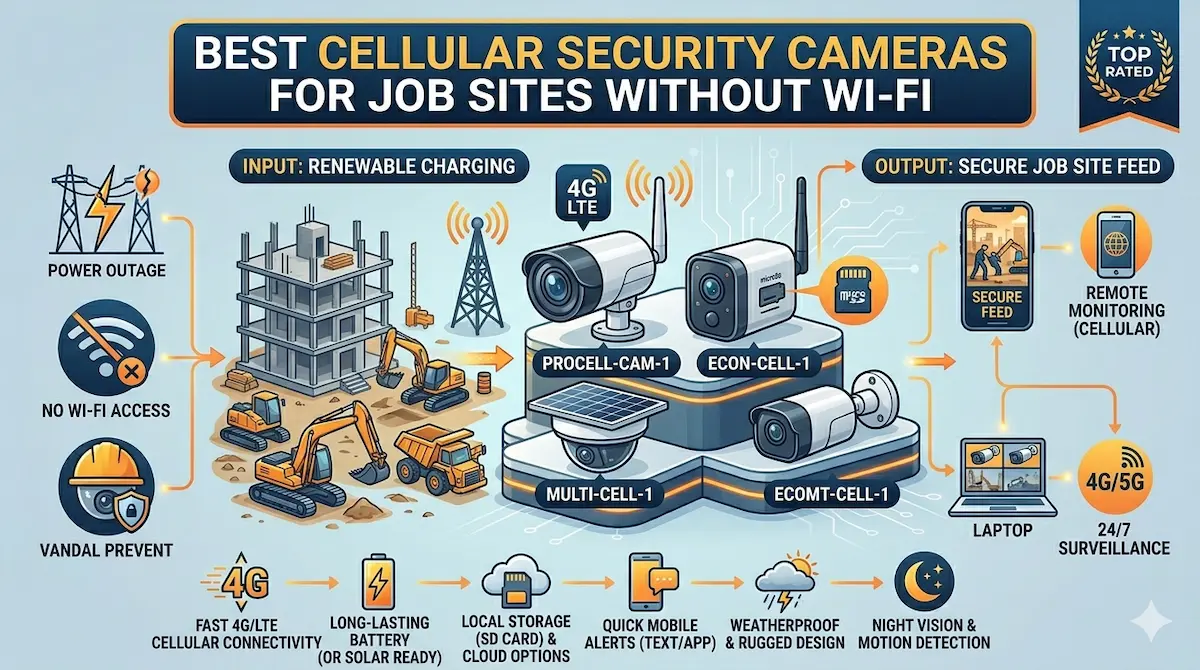
Quick Answer
For job sites without Wi-Fi, cellular security cameras offer reliable monitoring via 4G/5G networks. Look for models with long battery life, durable builds, and clear night vision. Consider data plans and signal strength in your area when choosing a camera.
Securing job sites in remote areas without Wi-Fi can be challenging. Cellular security cameras provide a solution by using mobile networks to transmit footage. These cameras are ideal for off-grid job sites where traditional internet access is unavailable or unreliable. They eliminate the need for Wi-Fi routers, making them practical for temporary or remote construction zones.
Best For
- Job sites in remote areas
- Construction zones with no internet
- Temporary work locations
Not Ideal For
- Urban areas with strong Wi-Fi
- Homes with existing security systems
Key Takeaways
- Prioritize cameras with 4G/5G connectivity
- Check battery life for extended use
- Verify durability for outdoor conditions
- Compare data plan costs across models
Why Cellular Cameras Are Essential for Off-Grid Job Sites
Off-grid job sites often lack reliable Wi-Fi, making traditional security cameras ineffective. Cellular security cameras for off-grid job sites use 4G/5G networks to transmit video, ensuring coverage even in remote areas. This eliminates the need for complex wiring or local internet infrastructure.
These cameras are particularly valuable for construction, mining, and agricultural projects where internet access is inconsistent. They provide real-time monitoring and alerts, helping teams protect equipment, materials, and personnel without relying on fixed networks.
Key Factors to Prioritize When Buying
When selecting cellular security cameras for off-grid job sites, prioritize battery life, signal strength, and durability. Look for models with long-lasting batteries and solar charging options to minimize maintenance in remote locations.
Signal reliability is critical. Choose cameras that support multiple cellular bands and have strong signal boosters. Additionally, opt for weatherproof designs to withstand harsh conditions like rain, dust, and extreme temperatures.
Common Mistakes and Limitations to Avoid
One common mistake is underestimating data usage. Cellular cameras consume significant data, especially with high-resolution video. Without a proper data plan, costs can escalate quickly. Always check the manufacturer’s data consumption estimates.
Another limitation is signal coverage. Even the best cameras may fail in areas with poor cellular reception. Consider using signal boosters or hybrid systems that combine cellular and Wi-Fi where possible. Also, be aware that some models may lack advanced features like AI motion detection.
Setting Up Your System for Maximum Coverage
Proper placement is crucial for optimal performance. Position cameras to cover entry points, storage areas, and high-risk zones. Ensure they are within line-of-sight of cellular towers or signal boosters to maintain connectivity.
Pair your cameras with a reliable cellular provider that offers strong coverage in your area. Some providers offer dedicated IoT plans with lower data rates. Regularly test the system and monitor battery levels to avoid unexpected downtime.
Top Product Recommendations
Reolink Argus 3
Best for: Remote construction sites with limited solar access
Why it stands out: Combines 4G LTE connectivity with a 120-day battery life and built-in solar charging for continuous operation.
Main limitation: Requires a compatible cellular data plan and may have limited video resolution compared to Wi-Fi models.
Ring Stick Up Cam Battery
Best for: Short-term projects needing quick deployment
Why it stands out: Offers cellular backup when Wi-Fi fails, with easy setup and integration with existing Ring ecosystems.
Main limitation: Battery life is shorter than dedicated off-grid models, and cellular data usage can be high without a plan.
Lorex LNR21-760
Best for: Long-term monitoring in areas with inconsistent signal strength
Why it stands out: Features a 5G-ready design, 30-day battery life, and advanced motion detection for reliable surveillance.
Main limitation: Higher price point and requires a cellular plan with sufficient data allowance.
Pros and Cons
Pros
- No Wi-Fi required for operation
- Portable and easy to deploy
- Reliable in remote areas with cellular coverage
Cons
- Higher upfront cost than Wi-Fi cameras
- Dependent on cellular data plans
When DIY May Not Be Enough
Upgrade if your current camera has weak signal strength in your area, requires frequent battery replacements, or lacks features like AI motion detection. Consider models with 5G support or solar charging if you need longer-term reliability in extreme conditions.
Helpful Internal Links
Helpful External Resources
Frequently Asked Questions
Do cellular cameras work without any internet connection?
Yes, cellular security cameras for off-grid job sites use 4G/5G networks directly, eliminating the need for a local internet provider. However, they still require a cellular data plan from a mobile carrier.
How long do batteries last on cellular cameras?
Battery life varies by model, but most off-grid cellular cameras last between 14 to 120 days on a single charge. Solar charging options can extend this significantly in sunny conditions.
Can I view footage remotely without a Wi-Fi network?
Yes, as long as the camera has an active cellular connection and you have access to the monitoring app. Remote viewing works through the cellular network, not a local Wi-Fi connection.
Final Recommendation
Off-grid and backup-oriented products can work very well when matched to the right environment. If your site is remote, harsh, or mission-critical, it is worth thinking beyond entry-level DIY solutions.