
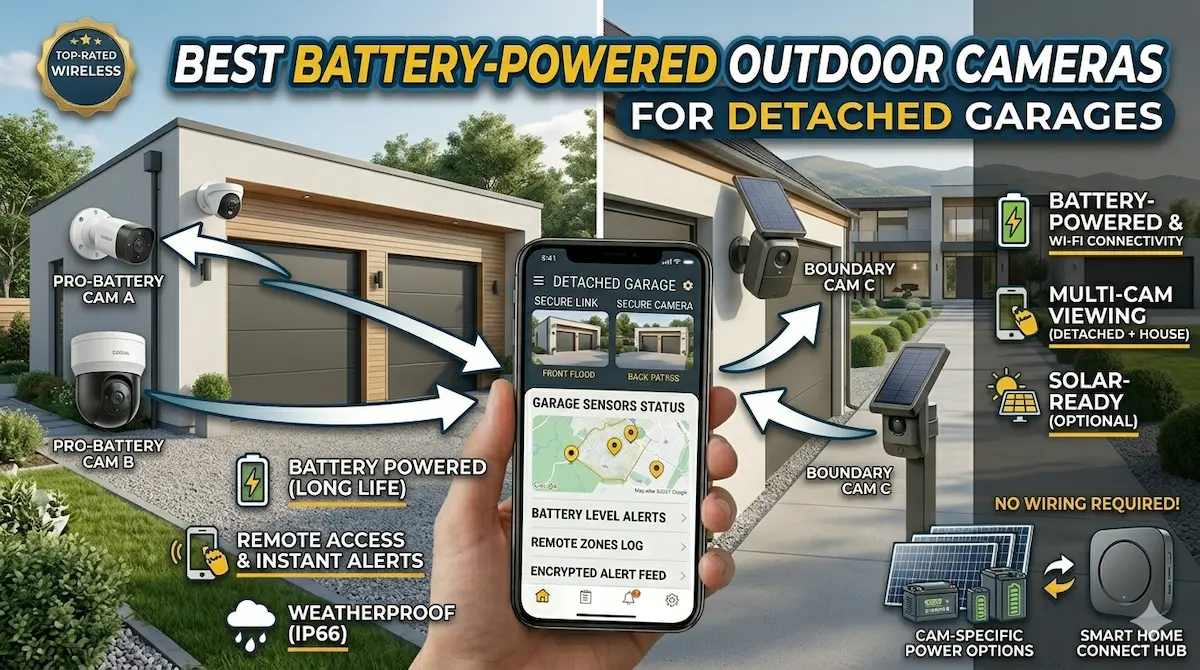
Quick Answer
For detached garages without power access, battery-powered outdoor cameras offer reliable security. Look for models with long battery life, weather resistance, and cellular or Wi-Fi connectivity. Prioritize cameras with motion detection and night vision to ensure coverage even in low light.
Detached garages often lack power sources, making battery-powered outdoor cameras a practical choice for security. These cameras eliminate the need for wiring while providing remote monitoring capabilities. When selecting models, focus on battery longevity, weather durability, and connectivity options to suit your needs.
Best For
- Detached garages with no power access
- Remote locations without wiring
- Users prioritizing easy installation
Not Ideal For
- Those requiring constant power supply
- High-resolution video needs
Key Takeaways
- Prioritize cameras with 12+ month battery life
- Choose models with IP66 weather rating
- Opt for cellular backup for Wi-Fi outages
- Verify compatibility with existing security systems
Key Features to Prioritize When Buying
When selecting battery-powered outdoor cameras for detached garages, prioritize long battery life, weather resistance, and clear night vision. Look for models with at least 6 months of battery life on a single charge, as frequent replacements can be inconvenient. Cameras rated for IP66 or higher are essential to withstand rain, snow, and extreme temperatures. Additionally, ensure the camera has a wide field of view (ideally 140° or more) to cover large areas without blind spots.
Connectivity is another critical factor. Opt for cameras that support Wi-Fi 6 for stable performance and faster data transfer. Some models also offer two-way audio and smart alerts via mobile apps, which can enhance security. Avoid cameras with poor motion detection accuracy, as false alerts can become frustrating over time.
Common Mistakes and Tradeoffs to Avoid
One common mistake is underestimating the impact of placement on performance. Cameras mounted too high or at awkward angles may miss critical details, while those near garage doors might be obstructed by vehicles or tools. Another pitfall is ignoring power limitations—some battery-powered cameras require frequent recharging if used in areas with heavy motion activity or extreme weather.
Tradeoffs often involve cost versus features. High-end models with 4K resolution or advanced AI detection can be significantly pricier. Additionally, cameras with solar charging capabilities may have bulkier designs or require extra installation effort. Balancing these factors ensures you choose a camera that meets your needs without overspending.
Setting Up Your Camera for Optimal Performance
Proper setup begins with positioning the camera to cover entry points, windows, and storage areas. Mount it at least 8–10 feet off the ground to deter tampering and ensure a clear view. Use a tripod or wall mount for stability, and avoid placing it near metal objects that could interfere with Wi-Fi signals.
Configure motion detection zones via the app to reduce false alerts. Enable night vision settings if your camera supports it, and test the camera during different times of day to adjust sensitivity. Finally, backup power options like solar panels can extend battery life, but ensure they are compatible with your camera model.
Why Battery-Powered Cameras Are Ideal for Detached Garages
Battery-powered cameras eliminate the need for complex wiring, making them perfect for detached garages where running cables to a power source is impractical. They are also easy to install and can be relocated as needed, offering flexibility for changing security needs. Unlike hardwired systems, they avoid the risk of electrical damage from moisture or rodents in outdoor environments.
These cameras often come with built-in solar charging options, reducing long-term costs and environmental impact. Their portability allows you to monitor multiple areas without additional infrastructure. However, users should be prepared for periodic battery replacements or recharging, depending on usage patterns and environmental conditions.
Top Product Recommendations
Ring Stick Up Cam Battery
Best for: Users seeking advanced motion detection and integration with other Ring devices
Why it stands out: Offers 6 months of battery life, 1080p HD video, and intelligent motion alerts. Works seamlessly with Ring Alarm and other smart home systems.
Main limitation: Higher price point compared to basic models; requires subscription for cloud storage.
Arlo Pro 4
Best for: Homeowners needing 4K resolution and solar-powered options
Why it stands out: Delivers 4K video, 180° field of view, and optional solar charging for extended battery life. Features advanced AI detection and two-way audio.
Main limitation: More expensive than competitors; solar panel not included in the base package.
Wyze Cam v3
Best for: Budget-conscious buyers wanting reliable performance
Why it stands out: Provides 1080p video, 30-day cloud storage, and 12 months of battery life. Affordable price with excellent value for money.
Main limitation: Lacks 4K resolution and advanced AI features found in higher-end models.
Pros and Cons
Pros
- No wiring required for installation
- Portable for temporary use
- Operate in areas without power
Cons
- Battery replacement needed periodically
- Limited storage capacity on device
When DIY May Not Be Enough
Upgrade when you need longer range detection, 4K resolution, or advanced features like AI person detection. Consider models with solar charging for extended battery life if your garage receives consistent sunlight.
Helpful Internal Links
Helpful External Resources
Frequently Asked Questions
How long do battery-powered cameras typically last?
Battery life varies by model and usage, but most last between 6 months to 2 years. Cameras with solar charging can extend this significantly, while those in high-motion areas may require more frequent recharging.
Can I use solar panels with any battery-powered camera?
Not all models support solar charging. Check the product specifications for compatibility. Some cameras require specific solar panels or adapters for optimal performance.
Do these cameras work in complete darkness?
Yes, most battery-powered cameras use infrared (IR) LEDs for night vision, allowing them to capture clear footage in low-light or complete darkness. Ensure the model you choose has this feature listed in its description.
What happens if the camera loses power?
Battery-powered cameras will continue recording until the battery is depleted. Some models send low-power alerts via the app, allowing you to recharge or replace the battery before losing coverage.
Final Recommendation
A practical wireless setup can solve many entry-level security needs, especially in apartments and rentals. If your property needs wider coverage, stronger reliability, or a more complete design, that is usually the point where a professionally planned system makes more sense.